
Folio Society Published Works Number 3201
Schliemann, Heinrich - Troy and Its Remains
We buy and sell items like these, so please contact us if you have similar items for sale, and we will make you an offer if we are interested.
To check if we have this item, or similar items, in stock, please click the Check Stock link below. Alternatively, use the links on the left to search our large online database of items for sale, or to visit the rest of the site.
Check Stock
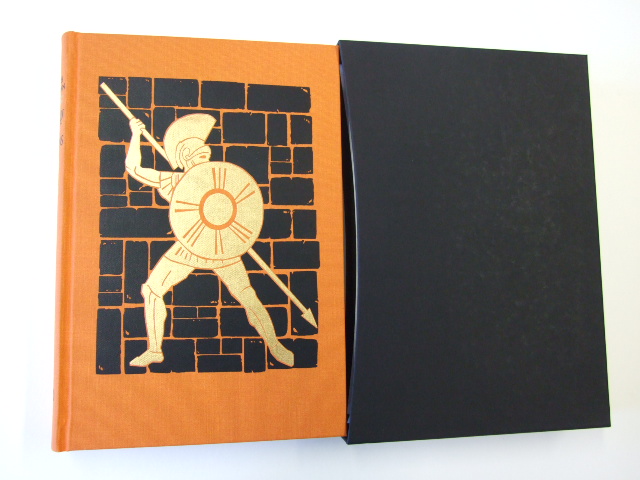
Schliemann, Heinrich - Troy and Its Remains (Published in by The Folio Society in 2015. Introduced by Caroline Moorehead. A story of adventure, obsession and discovery, accompanied by rare photographs. Bound in cloth, blocked with a design by Raquel Leis Allion. Set in Arno. 328 pages. Frontispiece, 24 pages of plates and a number of integrated illustrations. Printed endpapers. 10" x 6.75". For the educated classes of 19th-century Europe, the Troy of Priam, Helen and Paris, with its 'topless towers' immortalised in Homer's Iliad, was a romantic ideal. For most, it was a legend; its true location, if it existed at all, lost to the centuries. But, for the eccentric German adventurer and brilliant self-taught archaeologist Heinrich Schliemann, it was an absolute truth – within the pages of the Iliad was a literal map to be followed, a map that would become his life's obsession, leading him to a discovery that would transfix the world, and would become archaeology's greatest detective story. Troy and Its Remains, published in 1875, is Schliemann's account of his discoveries on and around the mound of Hissarlik, the site in northwest Turkey he resolutely believed to contain the ruins of the lost city. With trade-mark bravado, he recalls his first momentous dig as he enthusiastically uncovers each stratum of the ancient settlements within the hill. What he found would astound both his critics and supporters alike – a spectacular trove of gold and jewels, and myriad dishes, bowls, shields, swords, helmets, pottery and goblets. That Schliemann did, in fact, find Priam's Troy is now considered doubtful. The treasures more than likely belonged to another people who lived more than 1,000 years before the Homeric Age of Heroes. However, as biographer Caroline Moorehead writes in her introduction, regardless of his faults, Schliemann 'presented the world with a lost civilisation', and one of the most controversial legacies in archaeological science. Included in this edition is a selection of plates taken from the original German edition, Atlas Trojanische Alterthu¨mer. These rare photographs, taken at the time of excavation, capture the staggering variety of Schliemann's finds, from owl-faced pots to the dazzling 'Jewels of Helen'. )