
Folio Society Published Works Number 3017
Fussell, Paul - The Great War and Modern Memory
We buy and sell items like these, so please contact us if you have similar items for sale, and we will make you an offer if we are interested.
To check if we have this item, or similar items, in stock, please click the Check Stock link below. Alternatively, use the links on the left to search our large online database of items for sale, or to visit the rest of the site.
Check Stock
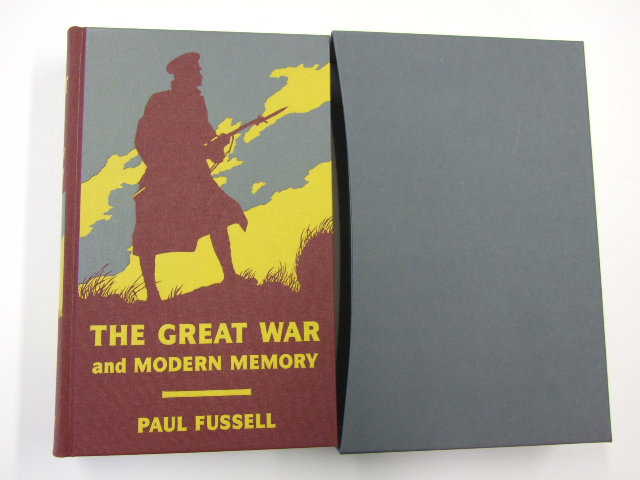
Fussell, Paul - The Great War and Modern Memory (Published in by The Folio Society in 2014. Bound in buckram, blocked with artwork by Frances Button based on a First World War Recruitment Poster, published by the Parliamentary Recruitment Committee, London, 1915 . Set in Janson . 464 pages . Frontispiece and 32 pages of colour and black & white illustrations . Printed endpapers . Book size:10" x 6.25" . In writing The Great War and Modern Memory, Paul Fussell's stated aim was suitably far-reaching: to understand 'the way the dynamics and iconography of the Great War have proved crucial political, rhetorical and artistic determinants on subsequent life'. Almost 40 years after it was first published, his lyrical and penetrating analysis of what the Great War means to our collective consciousness remains as powerful as ever. The First World War has come to epitomise the horror of mechanised warfare. As introducer Lyn Macdonald comments, this century-old war 'casts a long shadow into our own lives'. Paul Fussell, who served during the Second World War, published his award-winning exploration of why and how the'Great War' had become a part of our collective memory in 1975. Through a myriad of literary and artistic forms, he examines how the war'was generating new myth, and that myth is part of the fiber of our own lives'. Steeping himself in poetry, novels, memoirs and art, Fussell traces themes and images that have become familiar, from the innocence of the pre-war world to the'troglodyte' existence of trench and dugout. As well as great writers, Fussell draws upon an enormous quantity of unpublished material from ordinary soldiers, sometimes lyrical, sometimes filled with mordant humour. Fussell recalls how he felt on finding'little notebooks still stiff with the mud of the Somme or Ypres … identity disks, their string dark with the sweat of some hopeful boy'. This edition contains a powerful collection of images, from aerial views of fields scarred with shell holes, to poppies from No Man's Land. This book defies classification, encompassing history, literature and a deeply felt meditation on memory and culture. It is the work, as Fussell put it, of an essayist, rather than an academic. As such it remains a classic which continues to move and challenge its readers. )