
Folio Society Published Works Number 3011
Armstrong, Karen - A History of God
We buy and sell items like these, so please contact us if you have similar items for sale, and we will make you an offer if we are interested.
To check if we have this item, or similar items, in stock, please click the Check Stock link below. Alternatively, use the links on the left to search our large online database of items for sale, or to visit the rest of the site.
Check Stock
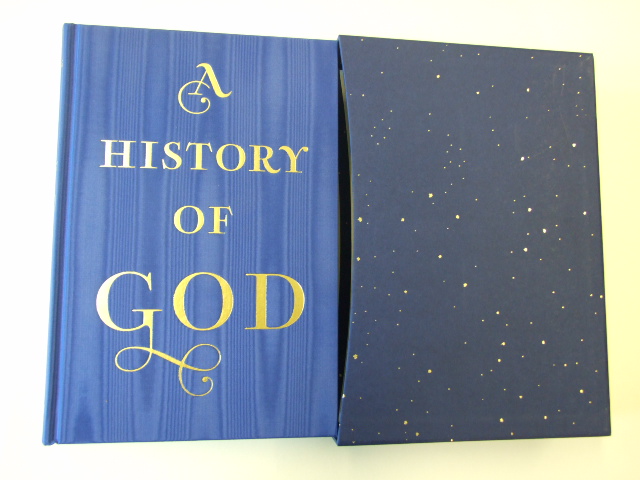
Armstrong, Karen - A History of God (Published in by The Folio Society in 2014. Introduced by Tariq Ramadan. In its first illustrated edition, Armstrong's acclaimed account even-handedly traces the troubled history of the three major monotheistic religions. Bound in art silk, blocked with hand lettering by Michael Gills. Set in Garamond with Perpetua Titling. 536 pages; frontispiece and 32 pages of colour and black & white plates. Blocked slipcase. 10" x 6.75". No single idea has played a more definitive role in the development of modern civilisation than that of god. However, with the growth of secularism over the centuries, beliefs in the divine are often approached in a reductive manner, lone icebergs in an ever-expanding and hostile ocean. Karen Armstrong's brilliant history traces the formation of these complex structures through the three major monotheistic religions over 4,000 years. In accessible and marvellously informed prose, Armstrong uncovers the troubled history of an idea that has both divided and inspired us, and underpins both our ethics of compassion and four millennia of conflict. Beginning with Abraham, the shared wellspring, Armstrong illustrates how the more personal, single god of Yahweh gradually eclipsed the primordial, polytheistic beliefs of ancient Babylon. From here she expertly traces the divergent prophetic philosophies that sprang from the concept of god, some dedicated to a rational philosophy, others mystical. Her balanced history demonstrates how each new notion of the divine distils past beliefs to suit evolving social conditions, from the painstaking disciplines of Kabbalah and Sufism to the scientific advancements of the Islamic Falsafah and the turmoil of the European Reformation. Armstrong, a former nun, approaches this challenge with an unerring respect for all religious concepts, no matter how surprising, but she is also unafraid to offer informed criticism. )