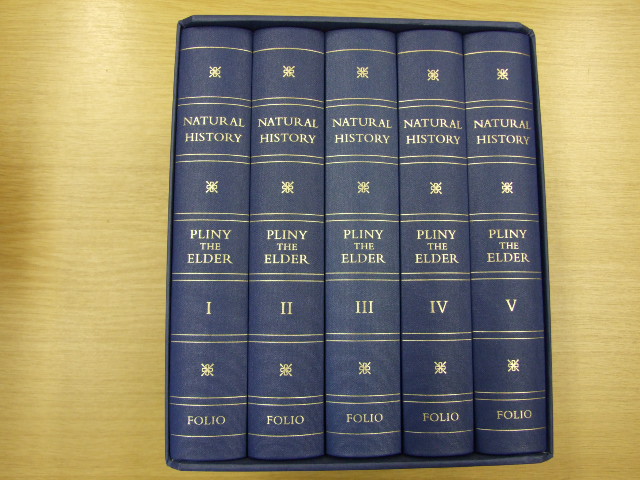

Folio Society Published Works Number 2670
Pliny the Elder - Pliny's Natural History
We buy and sell items like these, so please contact us if you have similar items for sale, and we will make you an offer if we are interested.
To check if we have this item, or similar items, in stock, please click the Check Stock link below. Alternatively, use the links on the left to search our large online database of items for sale, or to visit the rest of the site.
Check Stock
Pliny the Elder - Pliny's Natural History (Published in by The Folio Society in 2012. Boxed set of five volumes. Three-quarter bound in buckram with Modigliani sides. Blocked and printed with individual designs by Randy Asplund. Set in Bembo. 2,040 pages. 150 colour plates Book size in inches: 10.0 x 6.25. Pliny's Natural History contains a compendium of Roman knowledge - and our window on the ancient world. Pliny's Natural History is an astonishingly ambitious work that ranges from astronomy to zoology, covering botany, medicine, geography, magic, metallurgy and religion along the way. The world's first encyclopedia, it sheds a bright light on the Roman empire in the first century ad in both its physical and cultural aspects. From it we learn how the Romans mined metals, tended their crops, grafted fruit trees and healed their sick. It tells us which magical or astrological beliefs were common, and even how Romans liked to spend their money. Pliny for example disapproved of men's extravagance over silver tableware and women's over pearls. Through Pliny we know the Romans understood the world was round and revolved once every 24 hours. He scoffs at simple country folk who enquire why the persons on the opposite side don't fall off. Pliny's wide-ranging fascination with the world is infectious. The reader is quickly absorbed by the knowledge that women used asses' milk to remove wrinkles, that sons were shorter than their fathers (a sign of moral degeneracy, he explains), and that an actress was still performing aged 104. Yet this is more than just an entertaining book of marvels. It is the most complete picture we have of what people believed 2,000 years ago, how they lived and what their world looked like. Pliny described mining processes with pumps, sluices and shafts that disappeared from knowledge during the Dark Ages. Now archaeologists are uncovering traces of exactly the complex operations that Pliny detailed. For over a millennium, Pliny's work was considered to be the summation of human wisdom. He had collated material from over 2,000 source books, few of which survive. The convenience of Pliny's encyclopaedia allied to his lively style ensured that it was read and copied throughout Europe. The Natural History was studied by every scholar and doctor throughout the Middle Ages, from Bede to Petrarch, and every serious bibliophile had a copy. We know that Charlemagne, Henry II of England and the Duc de Berry owned copies. The fact that almost 200 manuscripts of the work survive is a testament to the regard in which Pliny must have been held. )