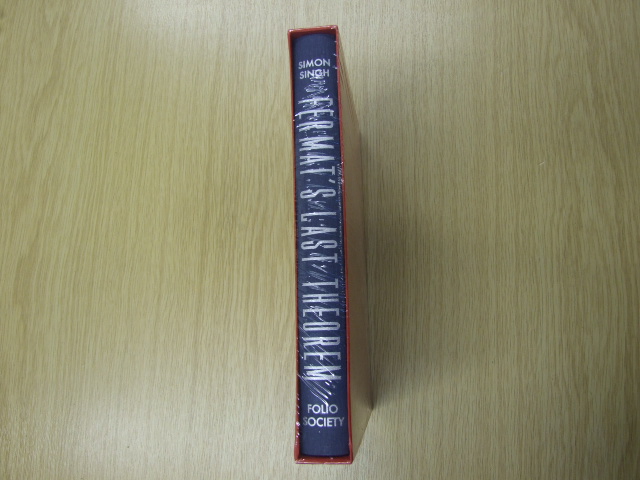

Folio Society Published Works Number 2638
Singh, Simon - Fermat's Last Theorem
We buy and sell items like these, so please contact us if you have similar items for sale, and we will make you an offer if we are interested.
To check if we have this item, or similar items, in stock, please click the Check Stock link below. Alternatively, use the links on the left to search our large online database of items for sale, or to visit the rest of the site.
Check Stock
Singh, Simon - Fermat's Last Theorem (Published in by The Folio Society in 2011. Introduced by Ian Stewart. Quarter-bound in cloth with Modigliani paper sides. Set in Baskerville. 264 pages. Frontispiece. 16 pages of colour and black & white plates. Book size: 9.5" × 6.25". On 23 June 1993, a rapt audience gathered in the main auditorium of the Isaac Newton Institute in Cambridge, packed the corridors outside and peered through the window. Word had gone around that a British mathematician called Andrew Wiles was going to demonstrate a proof for the most famous problem in mathematics: Fermat's Last Theorem. To stunned silence and then deafening applause, Wiles did just that. Though his work contained a flaw that would take a further two years to correct, he had finally solved a conundrum that had defeated mathematicians for over 350 years. Acclaimed science writer Simon Singh brilliantly reconstructs one of the greatest intellectual struggles in history, writing with a clarity that will enable any reader to appreciate the difficulties of the problem and the beauty of the solution. He describes the successive figures who brought humanity closer to the answer: Evariste Galois, who developed the concept of group theory before being killed in a duel at the age of 20, Yutaka Taniyama and Goro Shimura, the Japanese mathematicians who made crucial advances on elliptic equations and modular forms in the 1950s, and Andrew Wiles himself, who first determined to crack Fermat's theorem aged ten. What emerges is a deeply moving story of elation and despair, near misses and heroic achievement. Mathematician and author Ian Stewart has contributed a new introduction to a book he calls 'one of the classics of modern science writing'. )