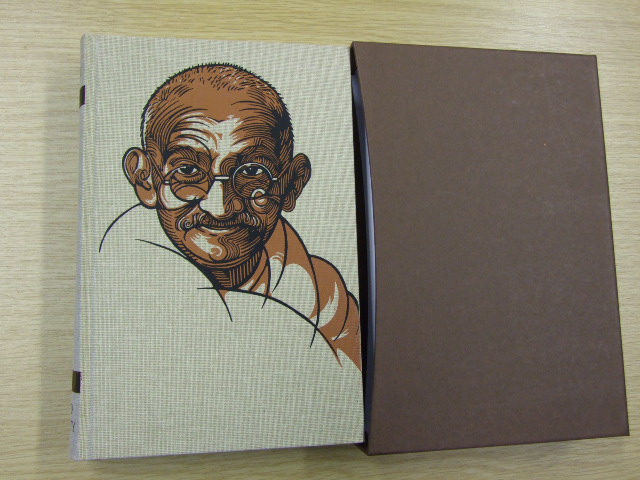

Folio Society Published Works Number 2264
Gandhi, M K - Gandhi: An Autobiography
We buy and sell items like these, so please contact us if you have similar items for sale, and we will make you an offer if we are interested.
To check if we have this item, or similar items, in stock, please click the Check Stock link below. Alternatively, use the links on the left to search our large online database of items for sale, or to visit the rest of the site.
Check Stock
Gandhi, M K - Gandhi: An Autobiography (Published in by The Folio Society in 2010. Introduced by William Radice. New glossary compiled by William Radice. Bound in cloth. Set in Erhardt. 472 pages. Frontispiece. 24 pages of black & white plates. Book size: 9.25" × 6.25". Born in 1869, Mohandas K. Gandhi – also known as 'Mahatma', or 'great soul' – became one of the most prominent and inspiring figures of the 20th century. In his acclaimed account of the first half of his life, Gandhi recounts his childhood in India, education in England and early legal career in South Africa, before his return home to take up the cause of Indian self-determination. It is also the story of how he developed his principle of 'satyagraha' – the steadfast, non-violent resistance to injustice that propelled the Indian struggle for independence and countless subsequent protests. Gandhi is endearingly candid in his descriptions of his marriage at 13 and his early struggles with 'carnal desire', as well as his experiments with meat-eating, carried out in secret as he knew that his parents would be horrified. While working in South Africa as a junior barrister, Gandhi fought for justice on behalf of indentured Indian labourers there. He experienced racism and assault and was initially banned from joining the Bar Council, but met these obstacles with the practical fortitude that became his trademark: when a white barber refused to cut his hair, he bought a pair of clippers and did it himself. All of his 'experiments', whether celibacy, fasting or cleaning toilets at a political conference, had one end: truth and justice. Returning to British-ruled India in 1915, Gandhi began to mobilise his fellow Indians in peaceful demonstrations against injustices; not just the 1919 massacre at Amritsar, but the martial law that followed, during which innocent men and women were imprisoned and persecuted. The measures he advocated, such as Hindu–Muslim unity and the abolition of untouchability, put him in mortal danger and displeased his friends and colleagues. But, as he so eloquently puts it, 'truth is hard as adamant and tender as a blossom'. Rare photographs of Gandhi's early life are included, and a new introduction by poet and scholar William Radice explores Gandhi's unique combination of humility, charisma and strength of will. )