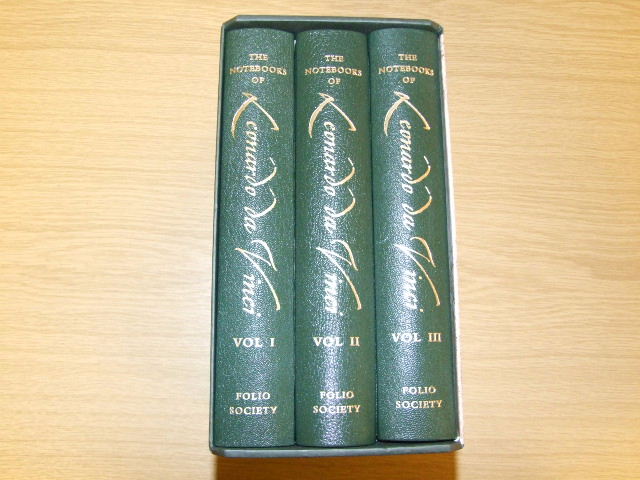

Folio Society Published Works Number 2047
da Vinci, Leonardo - The Notebooks of Leonardo da Vinci
We buy and sell items like these, so please contact us if you have similar items for sale, and we will make you an offer if we are interested.
To check if we have this item, or similar items, in stock, please click the Check Stock link below. Alternatively, use the links on the left to search our large online database of items for sale, or to visit the rest of the site.
Check Stock
da Vinci, Leonardo - The Notebooks of Leonardo da Vinci (Published in by The Folio Society in 2009. A major new edition in three beautiful illustrated volumes. The genius of Leonardo da Vinci (1452-1519) has never been rivalled. In the Mona Lisa and The Last Supper, he created the most iconic images in Western art, and to many he is simply the greatest painter who ever lived. Yet his brilliance extended well beyond these masterpieces. As well as his paintings, Leonardo left behind the most extraordinarily diverse body of written work ever created by one individual. Written in his unique mirror-writing, Leonardo's notebooks reveal his astonishingly prescient discoveries in anatomy, medicine, engineering, optics, architecture, hydraulics, botany and natural history. The illegitimate son of a notary and a peasant woman from the small town of Vinci, Leonardo had no formal education aside from his apprenticeship as a painter, which began at age 14. He knew no Latin, a huge disadvantage at the time. This very lack of education caused him to rely on his own observations and experience, rather than written authority a revolutionary new method, far ahead of its time. Training his all-seeing gaze on the world around him, Leonardo made deductions that are uncanny in their accuracy. 'The sun does not move,' he noted, 100 years before Galileo reached the same conclusion. He also found that 'Every weight tends to fall towards the centre by the shortest way', 150 years before Isaac Newton. In carrying out his experiments in anatomy, Leonardo realised that blood circulated around the body – a breakthrough in medicine that was later confirmed by William Harvey in 1628. And when he wrote of the 'quality of time as distinct from its mathematical divisions', he was setting out on a path that was later travelled by Einstein. Quarter-bound in leather with printed cloth sides. Specially commissioned introduction by Charles Nicholl, biographer of Leonardo.Set in Bembo, 1,432 pages with 98 pages of colour plates. 9.5 x 6.25 ins. )